
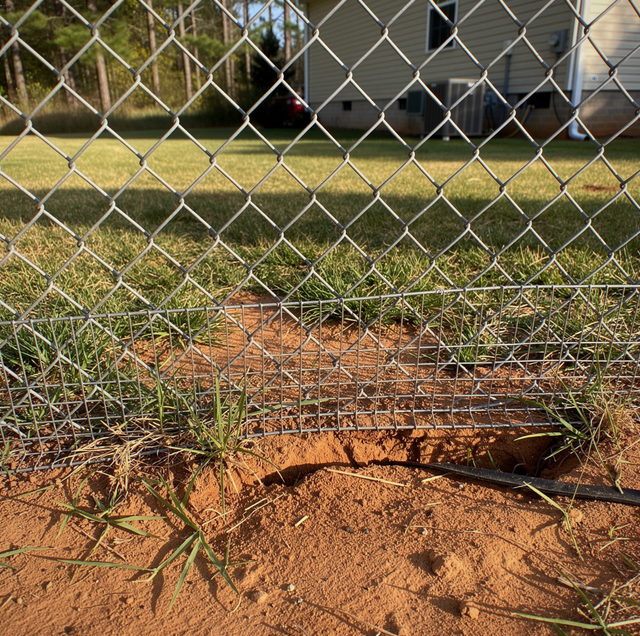
A chain-link fence can go up with nothing running along the bottom edge but bare ground, on the assumption that the top rail holds the whole line taut and the bottom takes care of itself. That assumption falls apart on a fence that faces wind, a curious dog, or a lawn mower passing close to the line. Nothing along the top holds the bottom edge in place, and the bottom edge is exactly the part of the fabric with the least support to begin with: it curls up off the grade over time, a dog finds the gap and pushes under it, and a loose lower edge flexes back and forth in a blow until the ties above it work looser too. A bottom-tension wire is the piece designed to close that gap, and whether a given fence needs one depends on what it has to withstand.
What a Tension Wire Is and How It Attaches
A tension wire is a heavier, stiffer coil spring than the mesh, run in a straight line along the base of the fence from one end of a section to the other, and its job is to give the bottom edge of the fabric something firm to hold onto rather than open air. At each terminal post along the run, the end, corner, and gate posts, the wire is wrapped around the post or bolted through a brace band set near the ground and drawn tight there, so the pull travels the length of the fence instead of stopping at the first loose diamond.
Between those terminal points, the fabric's bottom row is pinched to the wire with hog rings, small metal clips crimped closed around both the wire and the mesh at intervals along the run. Once those clips are set and the wire is drawn tight at both ends, the bottom edge behaves the way the top edge already does against the rail: it holds a straight line under its own tension instead of hanging loose and waiting for something to catch it.
Bottom Wire vs a Bottom Rail
A bottom rail does the same job with a rigid pipe instead of a taut cable, running the full width of a section and fastened to the fabric the same way a top rail is. Both close the same lower gap; they just get there by different means, and the table below compares how each one behaves in practice.
| Feature | Bottom Tension Wire | Bottom Rail |
|---|---|---|
| What it is | Taut steel wire clamped at the ends | Rigid pipe fastened the length of a section |
| How fabric attaches | Hog rings along the run | Fabric ties, same as the top rail |
| Ground contour | Can settle closer to a gentle rise or dip | Stays straight; a dip under it leaves a gap |
| Look | Nearly invisible from a few feet away | Visible horizontal line at the base |
| Adding it later | Retrofits onto an existing fence with less disruption | Can also be added later, with rail ends and brace bands, but calls for loosening the fabric first |
Because a rail is rigid, it holds a dead-straight bottom line, which suits a flat, graded yard where that clean line matters to the eye. Wire, being flexible along its length even while taut end to end, can settle closer to a yard with a gentle roll to it, since the fabric and wire together are not fighting a stiff pipe that wants to stay level over an uneven grade. Neither option is universally better; the ground and the look a homeowner wants decide which one fits. A fence built for a dog run or a large open area, where the bottom edge matters more for keeping something in than for the view, can lean toward whichever of the two an existing post layout already accommodates without extra fittings.
Which Fences Call for a Bottom Wire
A wire earns its keep wherever the bottom edge of the fabric is under a specific kind of pressure, and the situations below each put it there.
The first is a pet in the yard. A dog that pushes at a fence line finds any give at the bottom edge, because that's where a nose or a paw meets the fabric first. Fabric with nothing holding its lower row can be pushed up and out enough for a determined animal to slip under, while a taut wire gives that edge nowhere to lift.
The second is uneven ground. A yard with a roll or a shallow dip under the fence line leaves a rigid bottom rail sitting proud of the grade in spots, opening a gap right where a rail was meant to close one. A tensioned wire has more give and can be set closer to the ground at those low points without leaving the same clear opening.
The third is height and wind exposure. A taller run of fabric has more surface for the wind to push against and a longer unsupported bottom edge for that push to work on. On a run that takes hard, repeated gusts, the loose bottom edge flexes with every one of them and gradually loosens the ties above it, so a bottom wire earns a place on this list even on flat ground with no dog in the yard. Where the wind stays light, that particular pressure alone doesn't call for a bottom wire; instead, pets or the shape of the ground ends up deciding it. A wire pinned at both ends gives that edge much less room to move, but it doesn't make the fence wind-proof: the wire secures one edge of the fabric, and the posts underneath still carry the real load of holding the whole run upright.
With gloves on, lift the mesh near the ground at a few spots. Fabric that pulls up freely has no bottom wire, or its hog rings have come loose.
Retrofitting a Bottom Wire on an Existing Fence
A fence built without a bottom wire is not stuck that way. Adding one after the fact does not call for tearing the fabric down and starting over; a crew works the wire in along the base of an existing run, section by section, drawing it tight at the terminal posts on each end and clipping the fabric to it as they go.
The trade-off with a retrofit is that any slack already built into the fabric from years of sitting loose gets taken up as the wire goes in, which can mean the fence's bottom edge sits noticeably tighter to the ground once the work is done than it did the week before. That tightening is the whole point, though it's worth setting the expectation before the work starts rather than being surprised by how different a formerly loose fence looks once the bottom edge is finally secured. A run that has sagged and stretched over several seasons may also need a section of fabric re-tied along the top rail at the same time, since a bottom edge that has been loose for that long can pull the top out of true.
Tensioned fabric can spring back hard the instant a tie, hog ring, or the wire itself is cut, and the cut ends are sharp; leave loosening or retensioning an existing run to a fencing crew, not yourself.
What Happens at the Gate
Gates get treated differently from the fabric panels next to them. A chain-link gate panel is a welded or braced frame that maintains its shape along every edge, so it doesn't rely on a flexible wire the way an open run of fabric does. The posts flanking the gate still matter, since that's where the fence's tension wire and the gate's own hardware both anchor, but the gap the gate swings through isn't something a bottom wire crosses or supports.
Frequently Asked Questions
A crew crimping fabric to the wire places a hog ring roughly every 24 inches along the run, close enough that the fabric can't bow away from the wire between clips.
No. Some fences, especially economy or temporary runs, skip the rigid top rail altogether and use a tension wire along the top of the fabric instead, doing the same holding job without a pipe. A bottom wire does the same at the other edge, and the two don't depend on each other.
Yes. At a terminal post, the crew loosens the wire at its tie-off or brace band, draws it tight again, and re-fastens it, and the hog rings along the run stay where they are unless any have opened.
Yes. Because it stays rigid along its full length, a bottom rail resists pushing and prying on a run that takes heavy contact, such as a fence bordering a loading or work area, and it gives a mower or trimmer a solid edge to ride against instead of a strand of wire that can be nicked or caught.
That's handled at the gate itself, not with the fence's tension wire, since the wire ends at the two posts framing the opening. A lower-hung gate frame or a threshold strip fitted along the ground closes the gap instead.
Yes. A coated fabric pairs with a coated wire and coated hog rings, so no bare galvanized metal sits against the color coating at the clip points where it could show through or wear the coating over time.
Add a bottom wire to the chain-link run you already have — a crew fits it to the fence standing in your yard instead of replacing the fabric. AR Fence serves Fayetteville, Hope Mills, and Raeford. Call (910) 994-3634.