
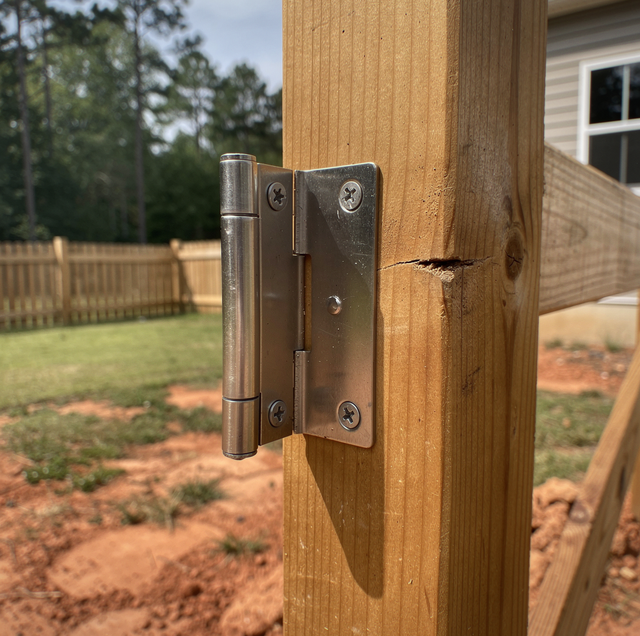
A gate is the only part of a fence built to move, and every swing loads a short list of metal: two or three hinges, the fasteners holding them into the post, a diagonal member, a latch and its strike, and on some gates a drop rod and a closer. Each piece has a rated job, a specific way it wears out, and a material and finish choice that decides whether it lasts two seasons or twenty.
Diagnosing a gate that has already dropped and sorting a leaning post from a racked frame are different questions this article does not take up. What follows starts from the hardware: what each component carries, how it fails, and what to specify so it holds.
What a Hinge Actually Carries
A gate hinge is a cantilever anchor, not merely a pivot. The load at each barrel is not the leaf's weight divided by the number of hinges; it is that weight multiplied by how far the leaf's center sits from the post. A six-foot leaf puts its center three feet out, pulling the top hinge away from the post while pressing the bottom hinge into it, and both take the full downward shear on top of that.
That is why a hinge set carries two published numbers, a weight rating and a maximum leaf width. A hinge rated for the gate's weight can still be undersized for its width, because width generates the pull-out force at the top barrel.
Strap hinges: a long metal arm laid across the face of the gate frame, with its mating leaf on the post. The length spreads the pull across several rails and fasteners rather than concentrating it on a single stile, which is why they are standard on wood gates.
Butt hinges: compact leaves mounted between the gate stile and the post edge. All the load lands on a few square inches, so they suit welded metal frames rigid enough not to need a spread, and they undersize quickly on a wide wood leaf.
Self-closing hinges: a spring wound inside the barrel that returns the leaf to closed. The spring is a wear item a plain hinge does not have, and the barrel does two jobs at once, carrying the leaf and storing the return force.
Through-Bolts, Lag Screws, and Where They Bite
How a hinge is attached decides as much as which hinge it is.
Through-bolt with washer and nut: the bolt passes completely through the post, and the nut and washer on the far side clamp the wood between them. The post goes into compression, the bolt carries the shear, and nothing depends on threads gripping wood.
Lag screw: the threads bite only into the wood they are driven into, so the holding power is whatever that fiber can give. Driven into long grain, along the side of a post, the threads cross many fibers and hold well. Driven into end grain, the cut top of a post or the end of a rail, they run parallel to the fiber and pull out at a fraction of that. End grain is the worst place on a gate to anchor a hinge, and it is where a rushed install often puts one.
The Diagonal Brace and the Anti-Sag Cable
A rectangular gate frame has no inherent resistance to racking: push on the top rail and the four corners pivot until the rectangle leans into a parallelogram. The diagonal member stops that, and there are two kinds working in opposite directions. Confusing them is the most common specification error on a gate.
Rigid brace, working in compression: a wood or steel member running from the bottom corner on the hinge side up to the top corner on the latch side. Its lower end bears on the frame above the hinge-side base, the supported part of the gate, and the member props the latch corner up along that diagonal, squeezed end to end. Fitted on the other diagonal, it would have to stretch to do any work at all, and a wood member in tension is only as strong as the fasteners in its end grain, which is close to nothing.
Cable and turnbuckle, working in tension: a steel anti-sag cable on the opposite diagonal, running from the top corner on the hinge side down to the bottom corner on the latch side. Tightening the turnbuckle shortens that cable, which draws the low latch corner up toward the high hinge corner and pulls the frame square. A cable cannot push, so on the compression diagonal it does nothing at all: it hangs slack while the gate keeps dropping.
Rigid member, bottom hinge to top latch. Flexible cable, top hinge to bottom latch. Either one fitted the wrong way round carries almost no load, and a cable has to land in the corner fittings, not mid-rail, since the folding force lives at the corners. A welded steel frame needs neither: its weld joints supply the rigidity, and its failure point is a cracked weld that no retrofit diagonal can correct.
Latch, Strike, and Drop-Rod Geometry
A latch is a geometry problem more than a strength problem. A gravity latch lets an arm fall into a strike, with perhaps a quarter inch of vertical engagement to work with. A spring-loaded bolt rides up a ramp on the strike and drops behind it, buying a little more margin because the ramp does the last of the aligning. A rigid keeper with a fixed slot has the least of the three.
The strike is the adjustable half of the pair. Its fasteners run through slotted holes so the plate can move up, down, in, or out on the post, which is how a technician restores engagement. Bending the latch arm to reach it destroys hardware: the arm is usually a cast zinc alloy that takes one bend and cracks on the second.
On a double gate, the inactive leaf is held by a drop rod sliding into a sleeve set in the ground or a fixed floor plate. The sleeve fails far more often than the rod: it fills with grit, silts up after rain, or shifts, causing the rod to land on the lip rather than drop through. A rod seated halfway still feels as if it has engaged, and the active leaf then latches onto a leaf anchored to nothing.
A gate that won't fully latch is a real hazard anywhere a pool or a dog is on the other side. Don't force the hardware or prop it shut; have a professional inspect and correct it promptly.
Closers and Spring Hinges as Wear Items
A hydraulic closer and a spring hinge do the same job by different means, and they wear along different curves. A closer loses force gradually as the seal in its fluid-damped cylinder begins passing fluid, so the gate slows early and stalls a few degrees short of the strike. A spring hinge stores force in a coil, and coil fatigue drops off abruptly: the gate closes normally for a long stretch, then rests visibly open within a season.
Both share one signature that separates them from an alignment problem: the gate travels its full arc under a push and fails only on the last few degrees under its own power. If the leaf binds partway through the swing instead, the closer is not at fault.
Planning a pool barrier turns on enclosure layout, release height, and approach paths rather than hardware mechanics. What matters mechanically is narrower: a closer is a consumable, and on any gate that closes itself it has the shortest service life of anything mounted on it.
Fastener Metallurgy and Galvanic Pairing
Hot-dip galvanized: a thick zinc layer formed by dipping the finished part in molten zinc, heavy enough to fill threads and leave a slightly rough surface. It is the standard finish for structural gate hardware left in the weather.
Zinc-plated: a thin electroplated zinc layer, bright and smooth, applied in a bath. It is the finish on most bulk hardware-store fasteners, and outdoors it is the first thing on a gate to rust.
Stainless steel: corrosion resistance built into the alloy rather than a coating, so a scratch does not open a path to bare steel the way a scratch through zinc does. Grade matters, since not all stainless behaves the same in constant moisture.
Putting two different metals together in a wet joint starts a galvanic reaction, and the less noble metal gives up material to protect the other. On a gate, the reaction eats the fastener rather than the hinge, because a small anode feeding a large cathode corrodes quickly. That is why one replacement bolt in the wrong metal can destroy itself inside a joint sound for years.
Match a replacement part's finish to the hardware already on the gate, not to whatever is on the shelf. A single mismatched fastener is a small anode in a wet joint, and it will corrode first and fastest.
Matching the Symptom to the Component
| Symptom | Component Usually at Fault | What Corrects It |
|---|---|---|
| Gate drags a groove in the ground | Loosened hinge fasteners, or a settled post | Reset or upsize the fasteners; a settled post needs a professional re-set, utilities located and marked first |
| Gap opens at the top-latch corner | Diagonal slack, broken, or fitted on the wrong diagonal | Re-tension the cable or refit the brace on the correct diagonal |
| Latch arm sits above or below the strike | Strike position, once the leaf moved | Move the strike on its slotted holes; never bend the arm |
| Gate rests a few degrees open | Closer seal or spring coil at end of life | Replace the closer or spring hinge as a unit |
| Double gate reads latched but isn't | Drop-rod sleeve silted or shifted | Clear and realign the sleeve so the rod seats full depth |
Frequently Asked Questions
Worn hinge pins let the leaf drift off the plane it was hung in, so the leading edge clears the latch post on the way open and catches on the way back. A barrel worn oval rather than round does the same. Self-closing hinges carry a tension screw that sets return force, but on a pool or child-safety gate that setting is part of the safety function, set and re-verified by a professional.
A dry squeak that quiets with a silicone-based spray is ordinary wear. Petroleum-based oil attracts grit, so the noise returns within weeks and an abrasive paste builds in the barrel. If the gate still binds after lubrication, the wear is in the pin or the barrel bore rather than in the film between them, which means it needs replacement.
Yes, and some pairings are far worse than others. A zinc-plated screw in a hot-dip galvanized hinge leaf is common: the thin plating is consumed quickly, and the bare steel beneath then sits against a large galvanized surface. Plain or plated steel in an aluminum frame is even worse, since aluminum and steel are far apart in the galvanic series. Stainless into stainless, or hot-dip into hot-dip, is why gate hardware is sold in matched sets.
No gap measurement separates the two reliably. What is checkable is the fastener: whether a screw head now sits proud of the leaf, whether a screw spins freely without drawing down, or whether the leaf has left an impression in the post so it no longer sits flush inside. Any of those means the anchorage has given up, and the repair is a larger fastener, a filled and re-drilled hole, or a through-bolt.
Beyond the rod itself, the inactive leaf needs a center gate stop, a small block or pin at the base, keeping the leaf from swinging past square before the rod can drop. Without it, the rod misses its sleeve by a fraction, and the miss is worst in cold weather when the steel has contracted.
No, and the latch is the one that gets overlooked. A closer's decline shows in how the gate travels as someone walks through. A latch fails at its engagement surfaces, and silently: the bolt or arm polishes a shallow ramp into the keeper, or the keeper's jaws spread a hair under repeated closing impacts, until the catch releases under a shove that would not have opened it new. Nothing about the swing changes, so the only way to find it is to push on a closed gate.
Have your gate hardware inspected — before a hinge, brace, or latch gives out for good. AR Fence serves Fayetteville, Hope Mills, and Raeford. Call (910) 994-3634.