
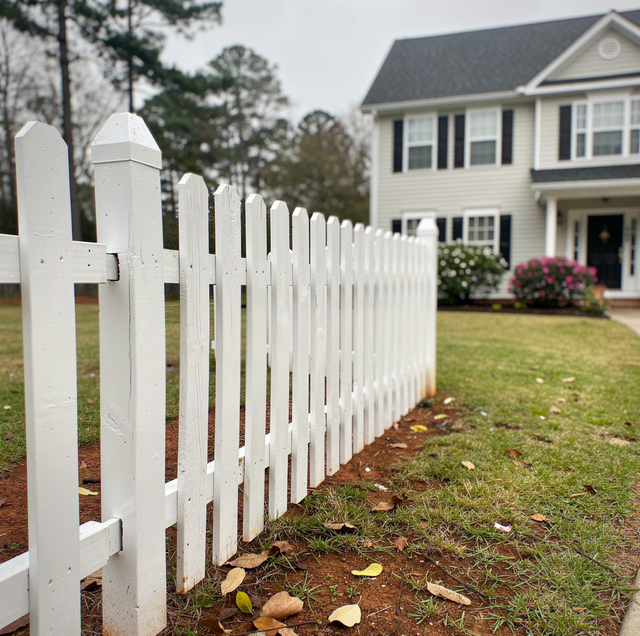
A fence borrows its lines, proportions, color, and material from the house behind it, whether the design is deliberate or accidental. From the street, anyone passing sees your house and fence as one composition, so a fence that ignores the roofline, trim, and siding can work against a home that would otherwise carry itself well. Matching a new fence to your home's style starts with the house itself: what it already has that a fence can pick up and repeat, and what a fence can safely leave out. That inventory comes before any catalog of fence styles.
House styles vary, and each one pulls toward a different fence line and set of details. The table pairs house styles with the fence line, material, and finishing detail that echoes each one:
| House Style | Fence Line & Proportion | Material & Detail That Echoes It |
|---|---|---|
| Colonial or Traditional Two-Story | Straight top line, evenly spaced pickets, capped posts | White or black picket with ball or acorn-style post caps |
| Craftsman or Bungalow | Low, horizontal emphasis | Horizontal board sections on square posts, natural wood or a dark stain |
| Ranch | Simple straight run, low profile | Split-rail or plain ornamental metal, understated posts |
| Farmhouse | Mixed open rail up front, board-on-board where it turns private | Wire-and-post combination or board-on-board wood, natural or painted |
| Modern or Contemporary | Clean horizontal or vertical lines, minimal ornament | Framed composite or metal panels, flush caps, no scrollwork |
| Brick-Front | Fence reads as a frame around the masonry | Ornamental metal panels set between mason-built masonry columns, black or bronze finish |
Reading the House First
Before you choose a material, your house gives up a short list of cues a fence can repeat. Roofline pitch and overhangs set a general mood: a steep gable reads as vertical and formal, while a low, wide roof reads as horizontal and relaxed, and a fence can lean its posts and pickets toward one direction or the other. Trim carries color and profile information you can borrow directly: window and door trim in a crisp white, a warm cream, or a deep charcoal gives you a starting palette for paint or stain instead of guessing at a shade that fights the house. Window grids and muntin patterns repeat small, regular divisions across the facade, and a fence built from evenly spaced pickets or balusters picks up that same rhythm rather than introducing mismatched spacing. Siding direction matters too: horizontal lap siding sits comfortably beside a fence built from horizontal boards or rails, while board-and-batten or vertical siding pairs with a fence that emphasizes its posts and vertical members. Reading these four cues- roofline, trim, window grids, and siding direction- gives you a short list to carry into a fence design conversation instead of an open-ended style search.
Height and Proportion Against the Facade
Height has its own local rules to check before you build; proportion against the facade can be worked out from the house alone. A fence that reads as short against a tall two-story facade can look like an afterthought, a thin line drawn along the bottom of a much bigger composition, while a fence that reads as tall against a low, single-story ranch can box the house in rather than frame it. Post spacing plays into that same proportion: wide-set posts along a long front run read as open and light, while closer spacing reads as denser and more formal, and either can suit a home depending on how solid or how open the facade already looks. Post caps and toppers are small details that carry weight in proportion, since a cap too large for the post below it draws the eye to the top of the fence rather than letting the roofline remain the tallest element in view. The goal is a fence line that runs along the side of your house in the view, supporting it rather than competing with the roofline for attention.
Color and Finish
Color and finish are where a fence either blends into your house or argues with it. A painted white picket or panel fence pairs cleanly with a white or light-trimmed house, carrying the same crisp line the trim already sets, while a natural wood tone left to age or lightly sealed suits a house with warm wood accents, exposed rafter tails, or stone. Stain tones that lean toward deep brown, gray-brown, or near-black read as more formal and recede against plantings and mulch beds, the opposite of a lighter, natural cedar tone that reads as more casual and shows off the wood grain. Black and bronze powder-coated metal fencing reads as a neutral, architectural line next to painted brick or stone siding, and it suits brick-front homes and homes with dark window frames or a dark front door. The finish decision is a matching exercise against whatever color is already fixed on your house: the roof, the brick, and the trim are the fixed points, and the fence is the piece built to match them.
Mixing Materials
A fence does not have to be one material end to end, and mixing is one move that ties a design to your house rather than working against it. Masonry columns, built by a mason to match the house's brick or stone, give a metal or wood fence a solid anchor at the corners and at the gate, borrowing your house's own material instead of asking paint or stain to do all the matching work alone. A front-yard run built with visible gaps between pickets or aluminum uprights can transition to a solid, gap-free style, board-on-board wood or a framed panel, at the side or back corner where your yard turns private. Hence, the open, decorative line stays where it is seen from the street, and the solid line takes over where screening matters. That transition point is worth planning as its own detail rather than an afterthought, since an awkward seam between two styles and materials draws the eye in a way a single consistent style does not. Keeping the same post size and cap style across both sections keeps the change from reading as two different fences bolted together.
A shovel or auger that hits a buried gas or electric line can ignite a leak or energize the tool. A public locate marks utility-owned lines only, not a private feed to a shed, so the crew digs after both are known.
Gates as the Focal Point
A gate sits at the one point in the fence line where you stop and interact with it, making it the natural focal point of a fence design rather than an interruption. A gate can pick up a detail from your house's front door: a matching arch shape, a matching post-cap style, or a contrasting panel design that frames the entry. On a fence built in an open style, a taller or more decorative gate section can mark the entry point without changing the height along the rest of the run. Hardware finish, meaning the visible hinges and latch, is a color decision as much as a functional one, and matching it to your front door's hardware or your house's exterior light fixtures ties the entry together in a way a mismatched finish works against.
Where HOA and Neighborhood Rules Enter
Style choices run into a limit once an HOA or a local ordinance enters the picture, and that limit is your own documents, checked before a material or color is picked. An HOA's architectural guidelines can specify approved materials, approved colors, or even a required style for street-facing fences, and those guidelines can sit separate from, and sometimes stricter than, general style advice. Your own HOA covenants, architectural review packet, or the local permitting office is the right place to confirm what your specific neighborhood allows before a material or color is picked, since a design that matches your house perfectly can still be denied for using an unapproved material or paint color. Your house sets the style direction; your own HOA and local rules set the boundaries within which style has to fit.
Frequently Asked Questions
No. Your house's paint and your fence's paint sit in different amounts of sun, splash-back, and ground moisture, so paint from the same batch still drifts out of an exact match once each surface has weathered under its own exposure. A painted or solid-stained fence in a close, complementary shade avoids that mismatch problem, since it was never meant to be identical in the first place.
Yes. Coated chain link matches when its frame matches too: posts, top rail, and fittings powder-coated in the same black or green as the mesh let the whole run recede against plantings, where silver posts under coated mesh still read as bare metal. Vinyl comes in picket and lattice-top profiles that echo a traditional picket line, and some vinyl lines come in tones other than plain white, allowing vinyl to fit into a modern or ranch-style palette.
Match the trim nearest your front entry rather than trying to split the difference across both styles. You and your visitors read the gate and the section of fence closest to the front door up close, while an addition set further back or to the side is seen from more of a distance, so anchoring the fence's detail to the entry trim settles the look even when a rear addition carries a different roof pitch or siding.
Not evenly. On any side that faces a street or the sidewalk, the style match matters, since that side reads as part of the house. A side or rear run facing only a neighboring yard, rather than the street, has room to shift to a plainer material or a different post spacing, because a neighbor reads it from their own yard rather than against your home's facade. A corner lot is the exception, since two sides face the street at once and both are expected to echo the house.
Match the house first, then any fixed hardscape, such as a walkway, driveway, or patio paver color, rather than the plantings. Plant color and fullness change with the seasons and over the years as shrubs grow or get replaced, while a walkway or driveway's material and color stay fixed, so a fence that echoes your house and its hardscape keeps its match through the seasons, while one chosen to go with whatever is blooming at the moment does not.
Yes. Fiber-cement and vinyl siding come in lap, shake and smooth-panel profiles, and each gives a fence the same cue real wood would: the narrow, staggered pieces of a shake profile pair with tighter picket spacing, and a smooth-panel facade pairs with framed panels and flush caps.
Engage a fence design and installation consultation — for wood, vinyl, composite, or aluminum fencing laid out to echo your home's rooflines, trim, and siding, from the front gate to the privacy run at the back. AR Fence serves Fayetteville, Hope Mills, and Raeford. Call (910) 994-3634.