
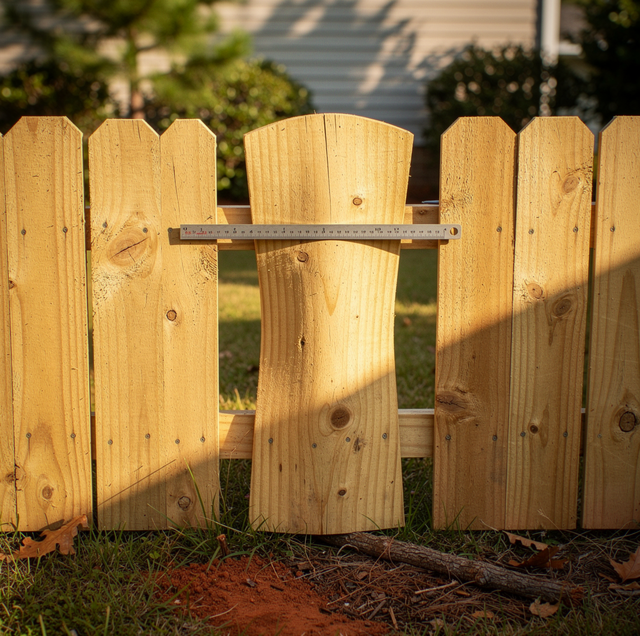
A picket that used to sit dead flat now has a shallow curve, easy to spot when the sun rakes across the fence line late in the day. Lay a straightedge across the face, and the middle stands a little proud of both edges, or the opposite: the edges lift, and the center sinks in. Nothing cracked. Nothing split. The board just stopped being flat, and the reason for that lives inside the wood itself, in the grain lines running across the face and the moisture moving through them every day the fence stands outside.
Wood is made of long, hollow fiber cells that absorb water vapor from humid air and release it when the air dries out, swelling and shrinking as they do. A single board has two faces, and if one face takes on or gives off moisture faster than the other, that face changes size while its twin holds steady. Locked together in the same piece of wood, that mismatch has nowhere to go but into a curve.
Ask for two fasteners per rail crossing, set toward the board's edges and driven flush rather than sunk. A picket held at a single center point can pivot as its faces dry unevenly, often where a twist starts.
Cupping, Bowing, and Twisting Are Different Kinds of Movement
A board can move in three distinct ways, and knowing which one you're looking at points to a different cause. Cupping is a curve across the width of the board, the face turning slightly concave or convex from edge to edge, and it's the movement fence pickets show most often because the two faces of a flat picket rarely see the same conditions. One face typically looks into the yard, catching shade from grass or shrubs; the other faces the property line, open to sun and wind. Different exposure means different moisture rates, and different moisture rates mean a cup.
Bowing runs the other direction, a curve along the length of the board rather than across its face, and it usually traces to two faces shrinking unequally along that length, due to irregular grain, reaction wood, or one face held wet far longer than the other. Twisting is different again: instead of a smooth curve, the two ends of the board rotate out of the same plane, and it shows up most in boards where the grain doesn't run straight down the length, so different parts of the same board are pulling in different directions as they dry.
The Cut Decides Which Way a Board Wants to Cup
How a board was sawn out of the log has as much to do with warping as anything that happens to it after installation. A flat-sawn board, the common cut for dimension fence lumber, has growth rings that run roughly parallel to its wide face rather than straight through it, which means one face sits a little closer to the tree's bark and the other a little closer to its center. Those two faces don't shrink at exactly the same rate as moisture leaves the wood, and that small difference is what curves a flat-sawn board even when both faces are treated the same. A quarter-sawn board, cut so the growth rings run closer to straight through the thickness, shrinks more evenly across its face and resists cupping better, though that cut is less common for ordinary fence pickets.
Species factors in, too, though weighing cedar against pressure-treated pine for how well each holds its shape is its own decision, made before the fence goes up; once the species is chosen, how the wood is cut, fastened, and cared for determines whether it stays flat.
Fastening Can Start a Twist It Didn't Begin With
A board that would have stayed reasonably flat on its own can still twist because of how it's held. A single fastener driven into the center of a board at each rail lets the board pivot around that point as its faces dry unevenly; nothing holds the edges in place, so the board rotates rather than staying put. Two fasteners per crossing, spaced toward the edges rather than the centerline, resist that rotation because the board would have to fight two points instead of one.
Overdriving a fastener head crushes the wood fibers immediately around it, which loosens the board's grip on that point and lets it rock slightly as it swells and shrinks, working the hole a little larger each cycle. A ring-shank nail or a coated screw holds its grip longer than a smooth-shank nail for that reason. Driving a fastener too close to the end of a board without pre-drilling often splits it, and a split board has less stiffness on one side of the crack than the other, which gives that end somewhere new to move.
Airflow Keeps Both Faces Drying at the Same Rate
A board pressed tight against thick shrubbery, a stacked woodpile, or mulch banked up its face dries far more slowly on that side than the open face looking into the yard, and that lag between the two faces is exactly the imbalance that starts a cup. A run of soaking rain followed by hard sun makes that lag worse, since the shaded face is still holding water when the open face has already dried out, and a species that moves less through that swing, cedar over pine, shows the difference later and by less than one that moves more. With little rain to soak the shaded face in the first place, the two faces start each dry spell closer together, and cupping has to come from something other than a wet-then-sunny swing. Keeping foliage trimmed a few inches clear of the fence and mulch off the base lets air move across both sides at closer to the same rate.
The same problem shows up when a rail, a piece of lattice, or a second layer of fencing sits flush against the back of a picket, with no space behind it; that contact blocks air on one face, the way dense shrubbery does on the other. A small standoff at the attachment points restores some airflow behind the board. Pickets butted edge to edge with no gap cup for a related reason: a swelling board with nowhere to go buckles, so the gap the installer sets for the board and the wood matters to flatness too.
A stain or sealer slows how fast a face trades moisture with the air. Coating only the show face and skipping the property-line face, because nobody looks at it, builds in the same face-to-face mismatch that dense shrubbery or a flush rail causes, and it can start a cup on a board that went up flat.
The Bottom Few Inches Move Differently Than the Rest of the Board
The last few inches of a picket, closest to the ground, sit in a wetter zone than the rest of the board for most of the year. Splash-back off bare soil during rain, moisture wicking up from the ground, and grass blocking airflow all keep that strip wetter for longer after every storm than the board's upper reaches, which dry in open sun and wind. That extra wetting keeps the bottom few inches swelling and shrinking across their width more than the rest of the board, which is why cupping, flared edges, and checks tend to show up first at the foot of a picket rather than higher up. Where wet spells and hard sun trade off through the year, that foot-level swelling runs wider than it does where rain is rare, and the ground around the fence stays drier for longer. Keeping the picket bottoms a couple of inches clear of soil and mulch, or stopping them on a separate bottom board, takes them out of that wet strip in the first place.
Frequently Asked Questions
The two faces of a flat-sawn board come from different distances inside the log, one closer to the bark side of the tree and one closer to the pith, and the bark-side face generally shrinks and swells more as it dries and rewets than the pith-side face does. That imbalance pulls the board into a curve toward the bark side as it dries out. Which face ends up concave can reverse once a dry board is soaked again, though, which is part of why face-orientation rules for vertical fence boards get argued more than they get proven.
A board with a shallow cup and no cracks can sometimes be pulled back close to flat by wetting the concave face and then weighting the board down flat while it slowly dries out of direct sun. Once a board has cracked along the grain, or has cupped deeply, the fibers have set into the new shape and won't hold flat again once released.
Often, yes, because kiln-dried lumber is dried under controlled heat to a target moisture content, typically near 19 percent or lower under standard grading rules, so it has already done much of its shrinking.
Yes. The grain around a knot doesn't run straight; it curves and interlocks around the branch that formed it, so that wood shrinks and swells at different rates and in different directions than the clear, straight-grained wood beside it. A board with a large knot near one edge, or several knots clustered together, has two zones fighting each other as moisture changes, and that fight tends to show up as a twist rather than a simple cup.
Yes. Wood shrinks roughly twice as much in the direction that runs around the growth rings as it does in the direction that runs across them, which is the underlying reason a flat-sawn board's two faces move by different amounts as the wood dries and rewets. That ratio is fixed by the wood's cell structure in the tree, not by anything that happens to the board once it's on the fence.
It can be worth checking for. Lumber marked KDAT, for kiln-dried after treatment, has been dried a second time after the preservative went in, so it starts closer to the moisture level it will hold outdoors and does less of that early shrinking than pressure-treated stock that ships to the yard still wet from the treating cylinder.
Have the cupped or twisting boards looked at on-site — a crew assesses whether it is the cut, the fastening, or a one-sided finish, and re-fastens or replaces only those boards. AR Fence serves Fayetteville, Hope Mills, and Raeford. Call (910) 994-3634.