
Storm-Damaged Fence? How to Read What Actually Failed
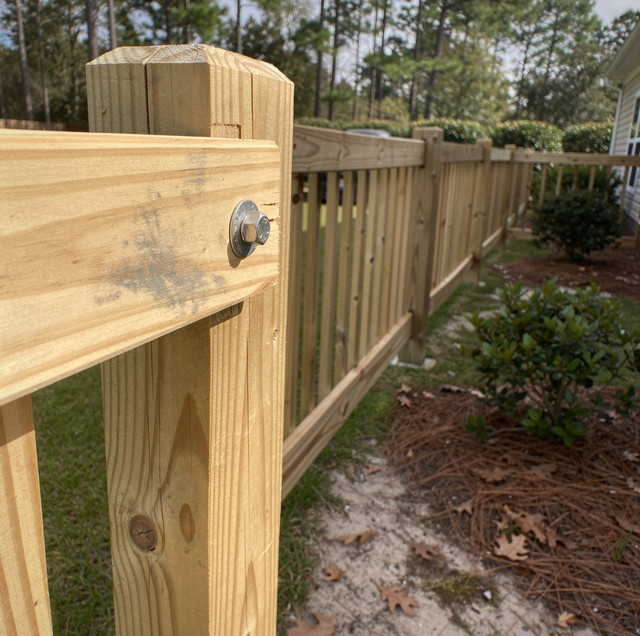
Two yards can take the same night of hard wind and end up with completely different wreckage. On one property, a run of posts has broken off at ground level, and the panels are lying flat where they fell. A couple of doors down, the posts are still standing plumb, and three panels are simply gone, boards scattered across the grass.
That difference is not luck. A fence moves wind force through five parts in a fixed order, and a storm finds whichever one of those five was already shortest on strength. Once you know the order, a yard full of debris turns into a readable answer about what actually failed, what has to be replaced, and what can be left alone.
The Five Parts, in Order
Wind pressure lands on the panel first. A panel holds nothing up on its own; its job is to collect pressure across its area and hand that load to something stiffer behind it. It hands it to the rails, the horizontal members to which it is fastened. The rails carry it sideways to the posts at each end. The posts convert that sideways push into a bending force at their base. The base passes it into the footing, and the footing spreads it into the soil.
Panel, rails, posts, footing, soil. Five parts and four handoffs, and the load has to survive every one of them. A solid privacy panel collects far more pressure than a picket or a rail design does, simply because it puts more area in front of the wind, but collecting the load is only the first step. What happens to it after that is decided entirely below the panel face.
The part worth slowing down on is that the force does not remain constant as it travels. It arrives at the panel as pressure spread fairly evenly over a flat face. It applies a concentrated pull to the fasteners, trying to draw each nail or screw straight back out of the wood. It reaches the rails as bending across an unsupported span. It reaches the base of the post as a lever, multiplied by the height of everything standing above ground. It reaches the soil as bearing pressure on a few square feet of dirt. Each part fails in its own particular way because each part is being asked a completely different question.
Every Chain Breaks at One Link
That is why a single gust causes two kinds of damage in neighboring yards. The five parts do not share the load between them. Each one hands it to the next, and the sequence continues until something cannot hand it on, at which point everything stops there.
Sound posts and generous footings under tired fasteners mean the boards let go first, and the posts never move at all. Solid fasteners and stiff rails over an undersized footing mean the posts go over with the panel still square and intact on top of them. Both fences met identical wind. Each one reported on its own weakest part and said nothing whatsoever about the other four.
The Two Links Everyone Names First
Ask why a fence went down in a storm and the answers come back from the bottom of the chain almost every time. Wood decays fastest right at the soil line, where moisture and oxygen both reach the fibers at once, so a post can look perfectly sound above grade while the inch below it has quietly lost most of its strength. Saturated ground grips a footing far less firmly than dry, compacted ground, which is why the same footing that holds through a windy afternoon can loosen in a storm that soaked the soil for hours before the strongest gusts arrived.
Both are real, and both are thoroughly covered ground. Neither is the whole chain. Between them they describe two of the five parts, both of them underground, and they say nothing at all about the two links sitting above the rails. That gap is where a large share of storm damage actually lands.
When the Covering Lets Go First
The third pattern leaves the posts standing plumb, the rails still bolted where they belong, and boards or entire panel sections torn loose and lying in the yard. This is a fastener failure, not a structural one. Everything built to resist bending did its job. What gave way is the connection between the covering and the frame.
Wind does not pull on those connections steadily, either. As a solid panel deflects under pressure, every board tries to rotate slightly against the rail behind it, and the fastener holding it takes that rotation as a pry: a pull straight out of its hole, repeated at whatever rate the gusts arrive. A constant push would be far easier on the connection than the gusting a real storm delivers, because each gust loads the fastener and each lull lets the wood spring back and work the hole a little wider.
Why Fasteners Are Usually the Shortest Link
Nails hold by friction and nothing else. A smooth-shank nail is gripped only by wood fibers squeezing against its sides, and every cycle of that in-and-out working enlarges the hole a fraction. Once the hole is wider than the shank, there is nothing left to grip with, and the nail backs out under a load it carried without complaint for years. Ring-shank and spiral-shank nails resist this far better because their profile gives the fibers something to catch on to rather than a smooth surface to slide along.
Screws bite. Threads engage the wood along their whole buried length rather than relying on side pressure, which is why a screwed board resists withdrawal far better than a nailed one. The exception is direction. A screw driven into the cut end of a board, into the end grain rather than through the face, threads between fibers that run parallel to it and has very little to hold onto. That connection was weak the day it went in and stays weak.
Corrosion finishes the job. A fastener rusting inside a damp board loses cross section right where it passes through the joint, and the same corrosion breaks down the wood immediately around it, so both halves of the connection weaken together. None of that is visible from six feet away, which is why fastener failures catch people off guard in a way that a rotted post does not.
Run a hand along the back of a panel where the boards meet the rails. A nail head standing a fraction proud of the wood, or a dark ring of rust-stained fiber around it, marks a connection already working loose.
Reading Which Link Gave
After the wind stops, the wreckage sorts into a small number of patterns, and each one points at a different part of the chain.
Posts Broken Off at or Just Below Grade
The break sits at the soil line, and the panel came down with it. The post was the short link, and the material at grade had been losing strength for seasons before the storm supplied the push.
Posts and Footings Levered Out of the Ground Together
The post is intact, the concrete collar came up still attached to it, and the panel above is often square and undamaged. The post did its job. The anchor holding it did not.
Boards or Panel Sections Torn Off Standing Posts and Rails
The frame held, and the covering did not. Putting new boards back on the same kind of fastener solves nothing, because the fastener is the part that failed.
A Whole Run Leaning as One Piece, Everything Still Attached
Nothing broke outright. The footings gave up some grip without letting go entirely, which usually means resetting the run instead of rebuilding it.
One further reading matters as much as any of those. When several posts near each other fail in the same storm at the same height, that run was built as one unit and has aged as one unit, and the posts still standing beside the broken ones are close behind. Replacing only the two that came down moves the next failure a season down the calendar instead of preventing it.
A fence resting against or tangled with a power line is not something to move or cut yourself. Treat it as an electrical hazard, call the utility company, and stay clear until it is confirmed dead.
The Fence That Survived but Is Not Undamaged
Standing is not the same as unaffected, and the links that quietly lost margin during the storm are the two nobody can inspect from the yard.
A footing can crack below grade, or lose part of its bond with soil that stayed saturated for days, without the post above it shifting a visible fraction. A fastener that held through the worst gust can have widened its own hole in the process, so the next storm starts with a connection that has measurably less grip than it had a week earlier. Neither of those announces itself during a walk down a fence line where everything still looks plumb and square.
What that means in practice is that a fence which came through a bad storm intact has usually spent something to do it. The margin that carried it through is smaller now than it was, and the two parts that gave up that margin are the hardest of the five to see: the footing under the ground and the fastener inside the wood. That is the case for looking closely at a fence that survived, rather than only at the one that came down.
Frequently Asked Questions
Not usually. Most residential fence panels do not arrive with a manufacturer's wind-speed rating printed on a spec sheet, as shingles or impact-rated windows do. That kind of formal rating shows up mostly on commercial and security fencing, so for a typical yard, wind resistance comes down to how the fence was built and set, and no product tag certifies it.
Yes, in some cases. Air squeezed through a narrow gap between two structures moves faster than the surrounding air, and faster air means more pressure on whatever sits inside that gap. A fence run wedged between a house and a garage, or between two neighboring homes, can end up loaded harder than a run on the same property that looks far more exposed.
Not necessarily, and it can mean the opposite. A rattling or whistling fence is shedding some of its load through the gaps, making the noise, since air moving through a gap is not pushing on solid material. A dead-quiet, rigid-feeling panel is often carrying more of the full pressure, not less, so noise on its own is not a reliable warning sign.
Yes. Airflow separates at the edge of any solid surface, and pressure runs highest near those edges rather than in the middle of a long face. The panels at each end of a run, and the pair meeting at a corner, carry a larger share of the load than an equivalent panel sitting mid-run, which is one reason those positions tend to show damage before the middle of the fence does.
Push firmly against each post near the top rather than only eyeballing the line, since a post that has lost grip below grade will move under hand pressure while looking perfectly straight standing still. Push from the side you can step away from, never toward a walkway, a vehicle, or another person, because a post with less left in it than you expected can bring its panel over with it.
Rarely from wind pressure itself, since so much air passes straight through the mesh or between the pickets. When an open fence does come down in a storm, it is more often an impact failure: a falling limb or wind-blown debris striking the fence, rather than wind load overwhelming the posts the way it can with a solid panel.
Have a fence read rather than guessed at after a storm — the footings and fastener connections that came through with less margin than they started with are the ones worth finding now. AR Fence serves Fayetteville, Hope Mills, and Raeford. Call (910) 994-3634.
