
Rot Board on a Wood Fence: The Part That Rots First
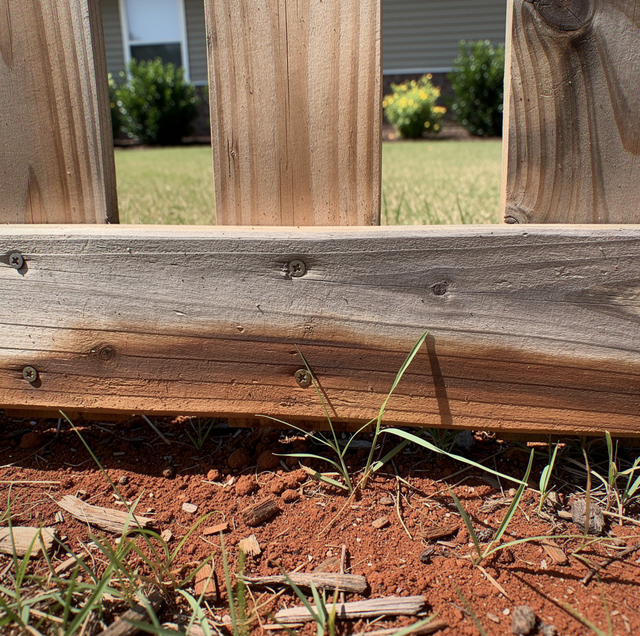
Soil sits against the bottom edge of your fence, an inch or two up the face of the lowest board. Rain runs down the pickets, strikes the ground at the base, and returns to that strip as spray. The sun clears the fence at midday and drops those bottom inches back into the shade by mid-afternoon. Air moving across the face of the pickets is slowed where the grass meets the wood.
A thumb pressed into that lowest board gives before anything above it does. On a fence built with a rot board, that softness is confined to a board carrying no load. Without one, the same softness is in the bottom ends of the pickets, and each runs the full height of the panel.
A Single Board Between the Pickets and the Dirt
A rot board is one horizontal board run along the very bottom of a wood fence, fastened to the posts, with the pickets stopping on its top edge rather than continuing into the soil. Fence crews also call it a kickboard or a mud board. It is cut from wider, thicker stock than a picket, and it is the member touching the ground under your pickets.
The board spans post to post along the bottom of each bay, below the lowest rail, and your picket line lands on top of it. A board in that position is sometimes fitted to close the triangular opening a stepped run leaves on a slope, a shape problem rather than a moisture one. On a level run, moisture is the only reason.
The name describes an outcome rather than a defect. A rot board is expected to decay, in a position where decay takes one board of your fence, and a fence detailed this way treats its bottom as a wear part instead of structure. Nothing about a picket line suggests one of its boards is expendable.
Ground Moisture, Splash, and the Zone That Dries Last
Wood decay has a moisture threshold under it. A national wood-science reference on biodeterioration puts decay at a wood moisture content at or above fiber saturation, usually about 30 percent, and at temperatures between 50 and 100 degrees Fahrenheit. A board standing clear of the ground sheds rain off its face and dries in wind and sun, crossing that threshold and dropping back. The lowest few inches of your fence get no such interval. Soil in contact with wood draws up liquid water by capillary action, and grass and the fence keep the sun and air off that strip, so the part that wets first dries last.
Rain that misses the fence still reaches it. Water striking bare soil or a hard surface at the base of a run rebounds onto the lowest strip as spray, so that strip is wetted twice by one storm, once down the face and once from underneath.
Wood also moves water faster along the grain than across it, because the cells that carried sap in the living tree run lengthwise through the board. A picket cut-off square at the bottom presents the open ends of those cells straight down into the wet ground.
A rot board interrupts that path. The board takes the soil contact and the splash, and your picket ends stop on its top edge, above the strip where water works.
The Failure Is Planned Rather Than Structural
Losing a rot board and losing a post are separate events. The board carries nothing. It spans between posts, holds no picket weight that the rails are not already holding, and, when it goes soft, your fence stands where it stood. A post is the member the line hangs on, and rot at the base of a post is a different failure with a different consequence.
That difference is why the trade works for you. A soft rot board comes out as a single board, in one bay, without the pickets above it moving. A picket line that has spent years standing in soil is a run of boards with a rotted foot on each, and every one is fastened through your rails at two heights.
Lumber Rated for Soil Contact, and a Gap Beneath It
Preservative is forced into treated stock under pressure, and how much of it remains in the piece depends on the exposure the piece was treated for. A board lying flat on bare graded soil touches a moisture source along its whole bottom edge and gets no dry interval. Held a small gap clear of the ground, the same board is wet while the ground is wet and dries between times.
Where water goes once it reaches the base matters as much as the gap. Ground sloping toward your fence line delivers runoff to the board and holds it against the wood; ground falling away carries it off. A board in a low spot that ponds after every storm is working in conditions the stock underneath it was not treated for.
Mulch and turf creep upward over the years. A base that started with a gap can be buried by a bed rebuilt against it, and once soil is banked against your pickets rather than the board, that board has stopped being the lowest wood on your fence. Your pickets are back in the ground.
Fastened So the Board Comes Off Alone
An installer drives the rot board's fasteners into the posts' faces and lets your picket line land on the board's top edge rather than run through it. That single choice is the reason the component can be replaced. The heads sit on the outside face of the board, where a driver reaches them without touching anything above; the pickets are fastened to the rails, so nothing above the board depends on the board holding. When the board has taken as much ground moisture as it is going to take, backing its fasteners out frees it, and your fence stands where it stood. Where pickets have instead been nailed through the bottom board, that board cannot come off until the picket line does.
The fasteners in that board sit in wood held at ground moisture, and today's preservatives are copper-based. Fastener manufacturers' guidance on preservative-treated wood reports the treated-wood industry's recommendation of hot-dip galvanized or stainless steel fasteners, and draws a distinction a shelf label may not carry: electroplated and mechanically galvanized coatings, it states, should not be considered hot-dip galvanized. Fasteners hot-dip galvanized after fabrication are coated in accordance with a national galvanizing standard. Two screws described as galvanized can arrive at the end of the board's service in very different condition. On the one member of your fence that somebody is expected to unscrew years later, the coating on that screw is part of whether your board comes off in one piece.
Frequently Asked Questions
Load. A bottom rail spans post to post as a structural member and carries the pickets' fasteners in shear, so it is sized and fixed for that work. A rot board carries only itself. If your fence has both, the rail sits high enough to stay clear of the wet strip, and the board underneath your pickets takes the ground contact the rail is being kept away from.
A board let in between the posts is cut to fit each bay on its own, because bay-to-bay spacing on a built fence varies enough that every opening gets measured separately. A board run across the post faces spans past them and can be spliced at a post, which moves faster on a long run but leaves the board proud. Which of the two your fence has changes how your replacement is measured and how you order it.
Better than a picket, which is part of why it is down there. Treatment penetrates the outer shell of a board more completely than it does the core, so a trimmer line cutting a groove into the face opens the wood less than it did the surface. On your own fence, the place to look is where your grass grows longest, because a groove there holds water and soil against your board between rains.
Not for the reason a wood fence does. Neither material decays, so nothing at the bottom of those fences is being given up to protect what sits above it. Vinyl systems still carry a bottom rail close to grade, and composite boards come with a ground-clearance instruction printed in the installation literature that ships with them. If you are replacing your wood fence with either, the detail you carry over is the clearance, not the sacrificial board.
A board in ground contact can only dry through the exposed faces, so a heavy film finish on those faces slows the one drying path it has left. Treated-wood industry guidance for homeowners aligns with the general recommendation to use semi-transparent oil-based stains on treated wood. If you finish your fence, the bottom board is where to keep the film thin.
On the end tag stapled to it. Treated-wood industry guidance for homeowners says the tag lists the use category next to the preservative name and retention. The table is specific to Southern pine: micronized copper azole runs 0.060 pounds of active ingredient per cubic foot at UC3B, exterior above-ground, uncoated or with poor water runoff, compared to 0.15 at UC4A, which is general-use ground contact. Check yours before your board leaves the rack.
Setting the bottom of a fence line while the grade is still open — the rot board and the clearance under it go in ahead of the pickets, and a grading crew arriving afterward is working around a board that is already fastened. AR Fence serves Fayetteville, Hope Mills, and Raeford. Call (910) 994-3634.
