
Why Do Wood Fence Pickets Need a Gap Between Them?
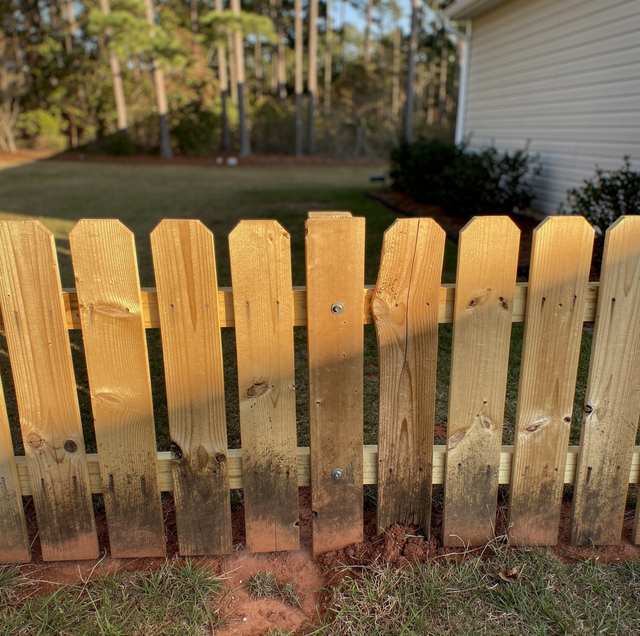
You noticed it on a Saturday morning, walking your fence line with a glass of tea sweating in hand. One picket had cupped just enough to catch the evening light differently, and you could see two boards pressing edge to edge, no space between them at all. You saw nothing broken. Your fence just looked tighter than it had in April.
That tightness is not your fence's flaw. Wood swells wide in wet weather and shrinks back once the air dries out, every year it stands in your yard. A picket fence needs a small gap between the boards for that movement, and if yours went up without one, the boards are showing you the difference now, before pressure runs out of room.
The Signs a Picket Fence Was Built Too Tight
A fence installed without any room for the boards to move gives itself away in a handful of specific ways. Pickets cup or bow along their length and stop lying flat against the rails. Board edges press so tightly together that you cannot slide a business card between them anywhere along the run.
Fastener heads back out and sit slightly proud of the wood, because the swelling board pushes against the nail or screw rather than settling around it. On a long run, that pressure does not stay in one spot. It travels down the fence line, board by board, all season.
What Loosens First When Boards Have No Room?
The fasteners go first, almost always. A nail or screw is driven to hold a board still, but a board with no gap has nowhere to swell except against its neighbor, so the two edges fight each other every time the humidity climbs. That fight transfers straight into the fastener, working the shank back and forth in the hole it sits in until the hole widens and the head no longer sits flush.
Once a few fasteners loosen, the board they were holding starts to shift on its own, and the gap you should have had between two pickets shows up somewhere you did not plan for it, at a seam that is now working when it should be sitting still. A fence built with the right spacing from the start never asks its fasteners to referee a fight between two boards that never had room to expand in the first place.
Why Wood Keeps Moving After It's Milled
Lumber does not cease to be a living material once it is cut into a picket. Wood fibers absorb and release moisture from the surrounding air for as long as the board is outdoors, swelling across the grain when the air is damp and shrinking back as it dries. That movement happens across the width of a board far more than along its length, which is exactly the direction two side-by-side pickets are fighting over when they sit edge to edge with nothing between them.
A fresh cedar or pine picket carries more moisture on the day you install it than it will months later, so a fence that looks snug at installation can loosen at the fasteners as the wood dries and then swell tight again the following summer. That cycle repeats for as long as the fence stands, which is the entire reason a gap belongs in the design instead of being left to chance in the workmanship.
What Loosens After a String of Humid Summers?
A humid climate like this one holds on to high moisture for a good part of the year, with long stretches when the air barely dries out overnight, even after sundown. A picket fence here goes through a wider swing between its wettest and driest months than the same fence would see in a dry climate, so the gap between boards is not a minor detail. It is doing real work every one of those months.
A fence built tight in a mild spring can look fine for its first season and still loosen by its third or fourth humid summer, once repeated swelling has worked every fastener and joint a little further than the year before. The boards do not fail all at once. They loosen a little further with each wet season until the fence needs the kind of full repair that a small gap would have prevented from the start.
The Gap a Standard Picket Fence Actually Needs
For a standard board-on-board or spaced picket fence, a small, consistent gap between boards is the fix, and it does not have to be wide to do its job. The goal is not a see-through fence. There is enough room for a swelling board to go somewhere besides the board beside it, so the fasteners hold and the panel stays flat through every season instead of only the dry ones. That same small opening also gives wind a place to go, so a run with no gap loads up like a solid sail, which is one reason it works its posts harder in a bad storm.
For a standard cedar or pine picket about 5.5 inches wide, leave a gap of about 1/8 inch between boards. Wide pine boards move more, so lean toward 3/16 inch instead.
That gap is not something a crew eyeballs once and forgets about. A crew holds it with a spacer, a thin scrap of wood or a purpose-made gauge held against the last board while the next one goes up, so every gap on the run comes out the same width, not wider in some spots and narrower in others as the work moves down the fence line.
Consistency matters as much as the exact number here. A run where the gaps vary from a hairline to a quarter inch, board to board, reads as sloppy work even though every individual gap technically does the job, and it gives some boards far less room to move than others, which is exactly the unevenness that shows up first the next time the humidity climbs.
How Board Width and Fasteners Change the Right Gap
Board width is the biggest variable in how much gap a fence actually needs. A wide picket you pick has more wood fiber running across its face than a narrow one, so it swells and shrinks by a larger amount even though the wood itself is moving by the same percentage either way. A 6-inch board provides more spacing than a 4-inch board cut from the same species and thickness.
Fastener choice plays a role too. A ring-shank nail holds tight and resists backing out, which keeps a board in place but does nothing to stop the wood itself from swelling, so the gap still has to do that work on its own. If you drive screws flush, they can crack a board at the edge when there is no room to move, which is another reason the gap belongs in the layout rather than left to chance during a quick repair.
Why a Privacy Fence Skips the Gap Rule
None of this applies to a privacy fence built the way privacy fences are meant to be built. A privacy design intentionally places boards side by side with no space between them, so no one can see through the fence from the street or a neighboring yard.
That is a different job with a different design, not a contradiction of the gap rule above. A privacy fence accepts more visible movement, a board edge that occasionally rides slightly proud of its neighbor, in exchange for a solid wall of wood with nothing to see through. A standard picket fence is not solid, so it does not get that trade-off; it needs the gap instead.
Waiting on a fence that was built without a gap does not fix anything; it only changes what eventually gets fixed. A season or two of tight boards fighting each other loosens fasteners one at a time until the whole run needs re-nailing, board by board, before anyone touches the real problem. Wait longer, and the boards themselves start to crack along the grain where they have nowhere left to expand, which turns a spacing fix into a full-panel rebuild, and the crew ends up pulling good lumber along with the bad because a cracked board rarely stops at the seam that started it. The gap you skip early is the labor you add back later, one loosened fastener and one split board at a time.
Frequently Asked Questions
No single number fits every fence and yard. The right gap depends on your board's width, its species, and how humid your yard runs, so your installer chooses the exact spacing once they see your pickets. What matters is that every board gets room to move without crowding its neighbor.
No. A standard picket or board-on-board fence needs it, since your boards are spaced apart. A privacy fence is different: its boards go up side by side with no gap, because blocking the view through it is the point. If your fence is the privacy style, this guidance is not about your panels.
The boards have nowhere to go when they swell, so they push against each other. That pressure loosens fasteners first, then shows up as cupped or bowed boards, and eventually as cracks along the grain where a board runs out of room. None shows on installation day. It builds quietly in your own fence until you notice it yourself.
Generally yes, a little. Pressure-treated pine tends to move more as it dries and re-wets than cedar does, so a pine fence often does better with a gap toward the wider end of the range your installer recommends. Cedar is more dimensionally stable and can sit toward the narrower end. Either way, your own board width and your yard's own humidity matter as much as the species you finally pick.
Sometimes, depending on how far along it is. If your boards are only cupping and a few fasteners have backed out, a fence crew can often re-space and re-fasten individual boards to open a working gap. Once boards have cracked along the grain, though, they usually need replacing, since a cracked board will not hold a fastener, no matter how carefully you reset it.
A properly sized gap reads as a shadow line, not an opening, from viewing distance, so it will not turn your fence into a see-through fence the way a wider gap would. What it gives you is a fence that stays flatter and straighter for longer, because every board has room to swell and shrink without fighting the boards next to it. If you want a solid look with zero gap anywhere, a privacy-style fence is the design built for that, not a standard picket tightened past what it needs. Ask your installer to show you both side by side before deciding.
Schedule a free on-site fence consultation — get your pickets measured, spaced, and fastened for how wood actually moves through our humidity, sun, and storms, not just for how the fence looks on a calm, dry afternoon each year. AR Fence serves Fayetteville, Hope Mills, and Raeford. Call (910) 994-3634.
