
How Long Does a New Fence Installation Actually Take?
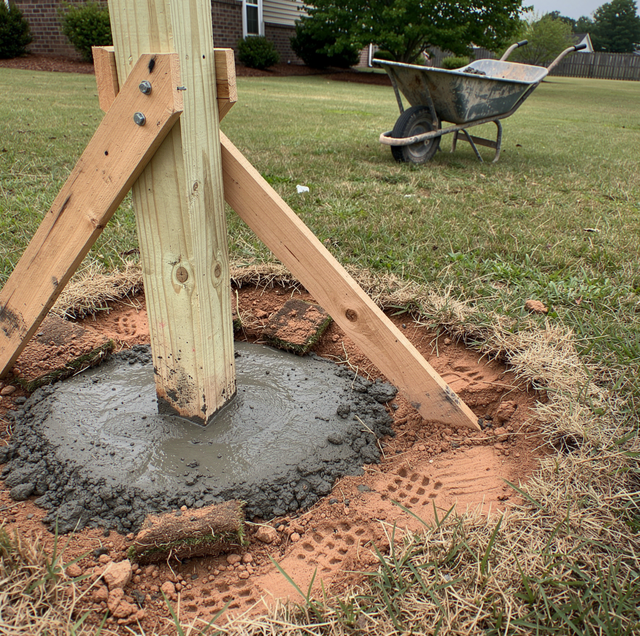
Most homeowners assume a fence installation is a single day of work: the crew arrives, the fence goes up, and the crew leaves. That assumption sets people up for a surprise, because an ordinary-looking privacy fence job can stretch across a week or more without anyone falling behind schedule. A fence isn't a single task. It's several trade steps stacked in sequence, and one of the biggest chunks of that sequence is time spent waiting on concrete to cure, not swinging a shovel.
Understanding what actually drives the calendar, material choice, total linear footage, number of gates, permit and utility-locate lead times, and the condition of the ground makes it much easier to set realistic expectations before the first post goes into the ground.
What Actually Sets a Fence Installation Timeline
A fence project moves through the same broad stages every time: layout and staking, digging, setting posts in concrete, letting that concrete cure, hanging rails or panels, and finishing with gates and hardware. What changes from job to job is how long each stage takes and whether stages can run back-to-back or have to wait on each other.
Four variables do most of the work in stretching or shrinking that schedule:
Material type: Wood privacy panels, built board by board on site, take longer per linear foot than pre-assembled vinyl or aluminum panel sections that a crew can drop into place. Chain link, with its top rail and mesh rolled out between posts, usually moves fastest of all.
Linear footage and layout complexity: A short, straight run with two corners digs and sets faster than a property line with a dozen corners, grade changes, or trees to route around.
Gate count: Every gate is its own small project: hinges, a latch or self-closing hardware, and a swing test, layered on top of the fence line itself.
Permit review and utility-locate lead time: Before a single hole is dug, calling a utility-locate service to mark buried gas, water, and electrical lines is a safety step, and that request needs a few business days to clear before digging can start.
Layout, Staking and the Pre-Dig Walkthrough
Before any digging begins, the crew walks the property line with the homeowner, marking corner posts, gate openings, and any spot where the fence has to jog around a tree, a slope, or a utility box. This step usually takes a few hours, not days, but it's also where hidden time gets saved or lost. If utility-locate flags haven't gone in yet, or a property line detail turns up a discrepancy, staking day can turn into a second short visit before digging begins.
Post-Hole Digging and Why Soil Conditions Change the Clock
Digging is where soil starts to matter. Loose, sandy soil digs fast. Heavy clay holds together but resists the auger and often requires hand cleaning at the bottom of each hole. Rocky ground can turn a five-minute hole into a twenty-minute one, hole by hole, across an entire fence line. Soil that's been recently saturated by heavy rain won't hold a post plumb, since the loosened dirt around the hole slumps back in before concrete ever goes down, so crews sometimes wait a day or two for the ground to firm back up. The same is true in reverse: extended dry stretches can bake clay soil hard enough that digging slows for a different reason entirely.
Concrete Cure Time Is the Part Nobody Budgets For
Press a thumb against a fence post the same afternoon it was set in concrete, and it will still give, just slightly, like pressing into a not-quite-set gelatin. That post isn't ready to carry a gate, a wind load, or a panel section pressing against it, even though it looks finished from ten feet away. Concrete needs real time to reach the strength that keeps a six-foot or eight-foot fence section standing through wind and years of temperature swings, and rushing the next stage is one of the fastest ways to end up with a leaning fence line a season later.
Rail, Panel and Picket Installation Once Posts Are Set
Once posts have cured enough to bear weight, the crew comes back to attach rails, hang pre-built panels, or, for board-on-board wood fencing, install pickets one at a time along the rail system. This is usually the fastest visible stage of the whole project, since the slow work of digging and waiting is already behind the crew. A vinyl panel section can go up at a noticeably quicker pace than individually placed cedar or pine pickets, simply because there are fewer individual pieces to level, attach, and space evenly.
Gate Hanging and Hardware Fine-Tuning
Gates go on last for a reason: the fence line needs to be complete, and the posts on either side of the opening need to be at full strength before the hardware is mounted and tested. Hinges get set plumb, latches get aligned, and the gate gets swung open and closed repeatedly to check that it doesn't bind, drag on the ground, or drift open on its own. Pool and other safety-focused gates get extra attention here, since the closing and latching action has to work correctly every time, not just most of the time.
Material Type Changes the Math
Different materials shift the schedule in different places. Wood and cedar fencing takes longer at the panel-and-picket stage because more individual pieces are being measured, cut, and fastened by hand; cedar's natural oils also make it hold up differently against sun and rain exposure than pressure-treated pine, which is a durability question more than an installation-speed one. Vinyl and composite fencing usually move faster once posts are cured, since panels arrive largely pre-assembled. Chain link and aluminum fencing tend to install the quickest per linear foot, since rolled mesh and modular aluminum sections cover ground fast between posts. Commercial, security, and industrial fencing projects usually take longer overall, not because the materials are installed more slowly, but because the runs are longer, the gate hardware is heavier-duty, and larger crews are often brought in to keep pace with a tighter completion window. Sports and school fencing, which frequently combines chain link with taller posts and reinforced gates, follows a similar pattern.
Permits, Utility Locates and Weather Windows
Two lead-time factors sit outside the crew's control entirely. Permit review, where required, can take anywhere from same-day approval to a couple of weeks depending on the project type, and that clock usually needs to run before digging starts. Calling for a utility locate before digging is a safety step, not optional, since it's the only reliable way to know where buried gas, water, sewer, and electrical lines run before an auger goes into the ground. Weather adds a second layer of unpredictability: high winds make it unsafe to handle tall panel sections or work off a ladder on gate posts, while heavy rain can turn a half-dug hole into a small pool. Neither delay is permanent, and both cut both ways depending on the season. Crews build weather days into realistic scheduling because losing a day to a storm is normal, not a sign anything went wrong.
Realistic Timeline Expectations by Project Size
| Project Scope | What's Involved | Typical Time in the Field |
|---|---|---|
| Small residential run (roughly under 150 linear feet, one or two gates) | Layout, digging, one concrete cure wait, then rail/panel and gate day | Often 2 to 4 working days spread across about a week |
| Larger residential run or pool enclosure (150 to 400 linear feet, multiple gates or corners) | Same stages, more holes, more hardware to fine-tune, sometimes a second crew visit | Roughly 1 to 2 weeks from staking to finished gates |
| Commercial, security, industrial, or sports/school fencing | Longer runs, heavier-duty gate hardware, larger crew, tighter completion windows | Can extend to several weeks depending on total footage and site access |
Frequently Asked Questions
Only under a narrow set of conditions, typically a short chain link or aluminum run under 100 linear feet with no gates, installed with pier blocks or driven posts instead of concrete-set posts. Skipping the concrete cure wait is what makes single-day completion possible, but it isn't an option for taller privacy sections or anywhere the fence will carry real load, like a pool enclosure or a gate.
A two-person crew working average soil typically sets 15 to 25 post holes in a full day. That number drops fast in heavy clay or rocky ground and climbs in loose, sandy soil, which is part of why two properties with the same footage can land on very different schedules.
Not automatically. Light rain doesn't halt layout or above-ground work like rail and panel attachment; what actually stops digging is standing water inside an open hole, since a post set in mud won't hold plumb. Frozen ground is a bigger obstacle for hand tools, though auger-mounted equipment can still break through it in many cases, so frost isn't an automatic multi-week delay either.
Usually a half-day to a full day, and the real time sink isn't pulling old boards or rolling up chain link mesh; it's breaking out old concrete footings so new posts can go into clean holes instead of fighting leftover concrete underground.
Concrete initially sets within hours, but it needs roughly 24 to 48 hours to reach the structural strength required to safely carry a gate's weight or resist wind pressure on a tall panel. Corner and gate posts, which carry more lateral load than a mid-line post, are sometimes given extra cure time before the crew returns for the second visit.
Yes, and double-gate driveway openings add the most time of any gate type: they need a drop rod or cane bolt set into a buried sleeve or a concrete pad to anchor the inactive leaf, which means an extra small concrete pour and its own cure time layered on top of the main post schedule.
A fence installation timeline stops feeling like a mystery once the stages are laid out: staking, digging, setting, curing, building out the line, and finishing the gates. Most of that schedule is dictated by physics and soil, not by how fast a crew can swing a hammer, and the projects that plan cure time and weather days in from the start are the ones still standing straight years later.
Schedule a free on-site consultation — get a realistic install timeline for your property before the first post goes in the ground. The Fayetteville Fence Company LLC serves Fayetteville, Hope Mills, and Raeford. Call (910) 994-3634.
